

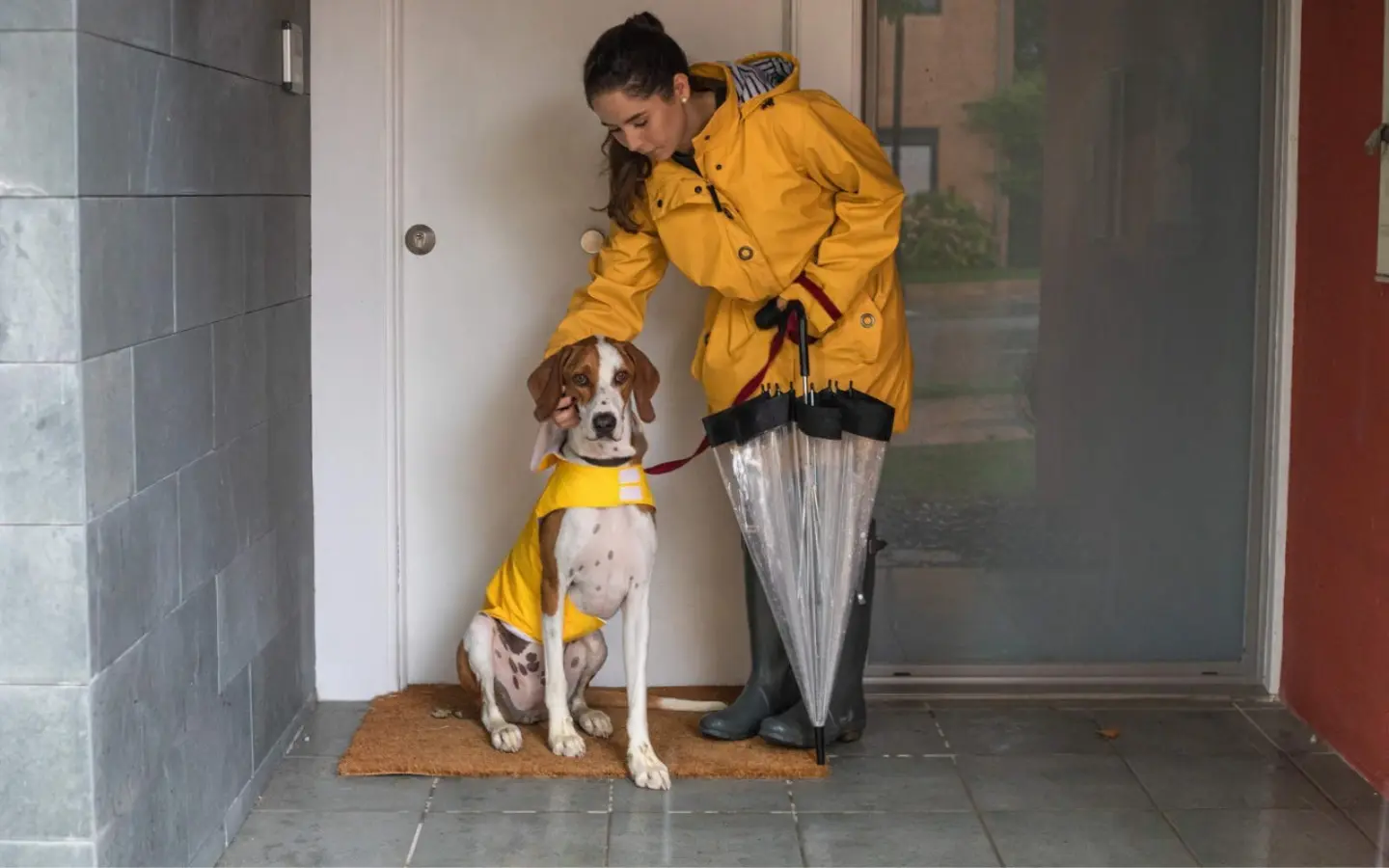
A guide to helping dogs go up and down stairs in raincoats
When dogs wear raincoats to go up and down stairs, they may move slowly, fall or feel scared due to the raincoats’ restraint, blocked view and reduced grip. The following provides a systematic solution from four aspects: risk analysis, auxiliary tools, training methods, and environmental optimization to ensure that dogs can safely and confidently complete stair movements.
First, risk analysis of going up and down stairs in a raincoat
1. Core risk factors
Visual obstruction
The brim or collar of the raincoat blocks the side and lower views
Dogs cannot judge the edges of steps and are prone to missing their steps, sprains or fractures
Limited movement
The cuffs/hems of the raincoat restrict the movement of the forelimbs and hindlimbs
Insufficient range of leg lifting, unable to cross the height difference of the steps, resulting in a fall and a strain on the hind limbs
The grip has decreased
The material of the raincoat (such as PVC) has low friction with the ground
The dog slipped on the slippery steps and couldn’t keep its center of gravity stable, slipping and hitting the steps
Psychological stress
The noise of raincoats (friction sounds) and clumsy movements can cause anxiety
Dogs refuse to go up and down the stairs and even develop long-term behavioral deterioration (such as refusing to go out) due to staircase phobia.
2. Risk level assessment
High risk
If the raincoat is too long, the stairs are slippery, or the dog is 8 years old or older, immediate intervention should be carried out (using assistive tools + restricting activities).
Medium-risk
The raincoat fits well but is made of smooth material. The dog has not adapted to the raincoat. Training assistance (desensitization training + environment optimization)
Low risk
Raincoats are lightweight, dogs are familiar with raincoats, and stairs are dry. Regular observation (stay alert)
Second, recommendations for mobility assistance tools and equipment
Tips for using auxiliary tools
Adjustment of anti-slip raincoat
Shorten the hem of the raincoat to 2-3cm above the ground to avoid stepping on it.
Make sure the cuffs are loose to allow the forelimbs to be lifted freely.
Traction rope assistance
Briefly pull the leash at the corner of the staircase to help the dog adjust its center of gravity.
Avoid pulling hard to prevent the dog from resisting.
Anti-slip shoe covers to wear
Let the dog get used to the shoe covers in advance (wear them for 5 minutes each time and gradually increase to 30 minutes).
Check if the shoe covers are loose to prevent them from slipping off.
Third, training methods for going up and down stairs
1. Basic training: Adapt to raincoats and stairs
Step:
Raincoat desensitization
Let the dog move freely on the flat ground wearing a raincoat, and combine it with snack rewards to establish positive associations.
Staircase contact:
On the dry staircase, guide the dog up and down with snacks, taking 1-2 steps each time.
Raincoat + staircase combination
After putting on the raincoat, repeat the staircase training and gradually increase the number of steps.
Tools:
Use snack bags (such as Wild One Treat Pouches) for quick rewards to maintain the training rhythm.
2. Advanced Training: Dealing with complex environments
Slippery staircase training
Sprinkle a small amount of water on the dry staircase to simulate a slippery environment.
Guide the dog to lift its legs slowly to avoid slipping.
Nighttime staircase training
Turn on the portable lighting lamp to illuminate the edge of the staircase.
Use verbal instructions (such as “Be careful” and “take it slow”) in conjunction with action guidance.
3. Emergency training: Handling after a fall
Step:
If the dog falls down, soothe it immediately (speak softly and stroke it).
Check for any injuries (such as swollen joints or lameness).
If the dog is not injured, use snacks to guide it to stand up again and avoid forcibly dragging it.
Tools:
Carry a pet first aid kit (containing iodophor and gauze) to deal with minor abrasions.
Fourth, safety measures
Code of Conduct for the Owner
Keep patient
Avoid urging the dog and allow it to go up and down the stairs at a comfortable speed.
Correct guidance
Stand at the side and rear of the dog and guide it to lift its legs with snacks instead of pulling the leash.
Timely intervention
If the dog shows signs of fear (such as trembling or freezing), stop training immediately and soothe it.
Fifth, a guide to avoiding pitfalls
Wrong practice:
Forcibly dragging a dog up and down the stairs: It can cause joint injuries or stair phobia.
A raincoat that is too long and not trimmed: Stepping on a raincoat can easily cause falls.
Neglecting the breathability of raincoats: Dogs are prone to heatstroke in high-temperature environments.
Misunderstandings in Choosing raincoats:
Full-coverage raincoat: Completely covers the limbs and restricts leg-lifting movements.
Raincoats without anti-slip patterns: Slippery surfaces are prone to slipping.
Sixth, Summary
Dogs wearing raincoats going up and down stairs need to reduce risks through three aspects: auxiliary tools (anti-slip raincoats, leashes), desensitization training, and environmental optimization. The owner needs to choose a suitable plan based on the dog’s age, size and type of staircase, and always maintain patience and safety awareness. If your dog shows persistent fear or is injured, stop training immediately and consult a veterinarian. Through scientific training and reasonable equipment, it can help dogs complete stair movements safely and confidently.