

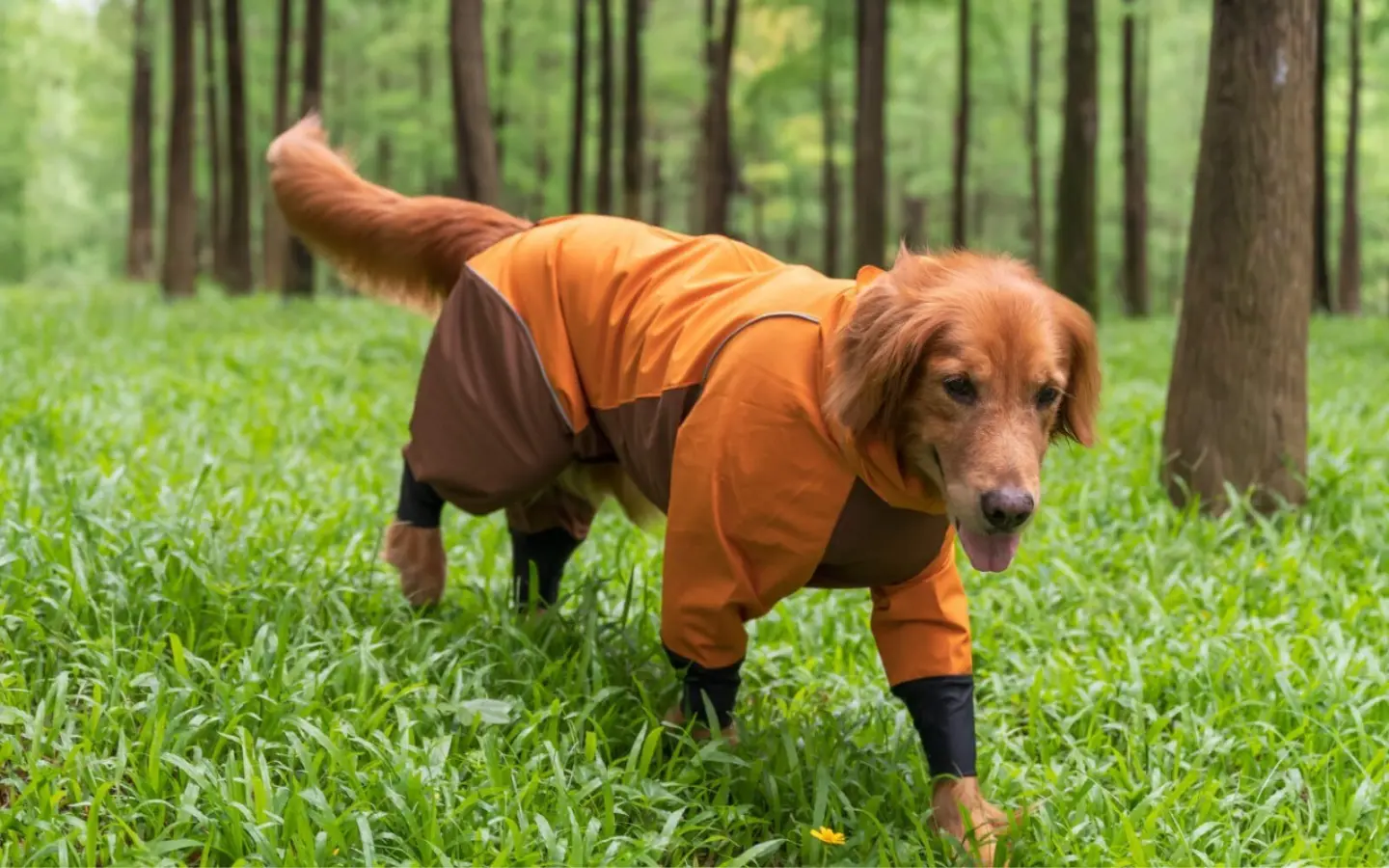
A guide to protecting dogs wearing raincoats from being scratched by tree branches when walking in the woods
In a forest environment, dogs wearing raincoats are prone to damage to their raincoats, skin cuts or being startled and struggling due to being caught by branches, rubbed by shrubs or entangled by low vegetation. The following provides systematic solutions from four aspects: raincoat protection design, walking skills, equipment assistance, and environmental prediction to ensure the safe passage of dogs through the forest.
First, key points for the scratch-resistant design of raincoats
The local protection of the raincoat has been upgraded
Shoulder reinforcement: Sew scratch-resistant patches (such as leather or silicone sheets) at the position of the shoulder blades to withstand the main friction of the branches.
Hip protection: A detachable scratch-resistant fabric is added to the back of the raincoat to cover the area from the hip joint to the tail root, preventing it from being scratched by low shrubs.
Reflective strip optimization: Change the reflective strip from surface to embedded sewing to prevent it from being caught and falling off by branches.
Second, techniques for preventing scratches when walking in the forest
Route selection and prediction
Prioritize open paths: Choose small paths with obvious signs of trampling and avoid areas with dense thickets of thorns and fallen trees.
Observe the height of the vegetation
Low shrub area: Let the dog follow closely, and the owner uses his body to block the bushes.
In the tall tree area: Use a long-handled umbrella or a branch to clear the obstacles ahead in advance.
2. Master’s guidance strategy
Traction rope control
Use a double-ended traction rope (one end connected to the chest and back, the other end connected to the collar), and the control direction can be quickly switched in an emergency.
Keep the leash loose but controllable to prevent the dog from bumping into the branches due to sudden pulling.
Instruction training
Train the “left/Right detour” command in advance to guide the dog to avoid areas with dense branches.
Use the “wait” command to make the dog pause in front of complex terrain, and let the owner assess the risk before moving forward.
3. Dog behavior management
Avoid lowering your head to sniff: There may be barbs or sharp objects on the ground in the forest. Use snacks to guide your dog to keep its head up while walking.
Do not gnaw on plants: Some plants (such as poison ivy) may come into contact with the skin through raincoats. Gnawing on them should be stopped immediately.
Third, equipment usage skills
Leg brace wearing:
Make sure the leg covers cover 5cm above the ankles to prevent them from slipping off.
Check if the inner side of the leg cover is smooth to prevent friction with the skin.
Mask adjustment
The edge of the mask should fit the dog’s face, but it must not press against the eyes or the mouth and nose.
For the first use, let the dog adapt for 10 minutes and gradually increase the wearing time.
Fourth, environmental risk prediction and Emergency response: Emergency response plan
Raincoat hooking
If the raincoat is caught by a branch, first soothe the dog’s emotions and then slowly unfasten it (to avoid violent tearing that may cause the raincoat to break).
If it cannot be untied, use a portable knife to cut off a part of the raincoat (keeping the key parts intact).
Skin scratch
Check the depth of the wound. If there is a large amount of bleeding, stop it immediately (press with sterile gauze).
Minor abrasions can be disinfected with pet iodophor and antibacterial ointment can be applied.
Lose direction
Keep your dog more than 3 meters away from your sight in the woods. If it gets separated, immediately call it with a whistle or a snack.
Carry a GPS tracker (such as Whistle GO Explore) to track the dog’s location in real time.
Fifth, long-term adaptability suggestions
Anti-scratch desensitization training
Beginner: Walk beside artificial bushes (such as potted plants) and gradually reduce the distance from the plants.
Intermediate: Use a branch to simulate the scraping action and train the dog to stay still in combination with the “Don’t move” command.
Advanced: Set up obstacle tracks in the woods, requiring dogs to pass quickly and avoid hooks.
Regular maintenance of raincoats
After each walk in the woods, check the raincoat for any wear or hooks, and repair or replace it in time.
Use a soft-bristled brush to clean the adherents on the surface of the raincoat (such as tree bark and soil) to avoid corroding the fabric.
Health monitoring
After walking, check the dog’s skin for any redness, swelling or scabs (which may be hidden wounds caused by scratching).
If a dog frequently scratches or licks its body, it is necessary to check whether the skin irritation is caused by the hooking of a raincoat.
Summary
When walking in the woods, dogs wearing raincoats need to avoid being scratched by branches by optimizing the protective design of the raincoats, mastering walking skills, using professional equipment and predicting environmental risks. The owner needs to flexibly adjust the plan based on the density of the forest, the type of vegetation and the dog’s size, and enhance its ability to cope with complex environments through long-term training. If a dog has severe scratches or its raincoat is damaged, it should be taken to the hospital in time and its equipment replaced to ensure its safety when walking later.