

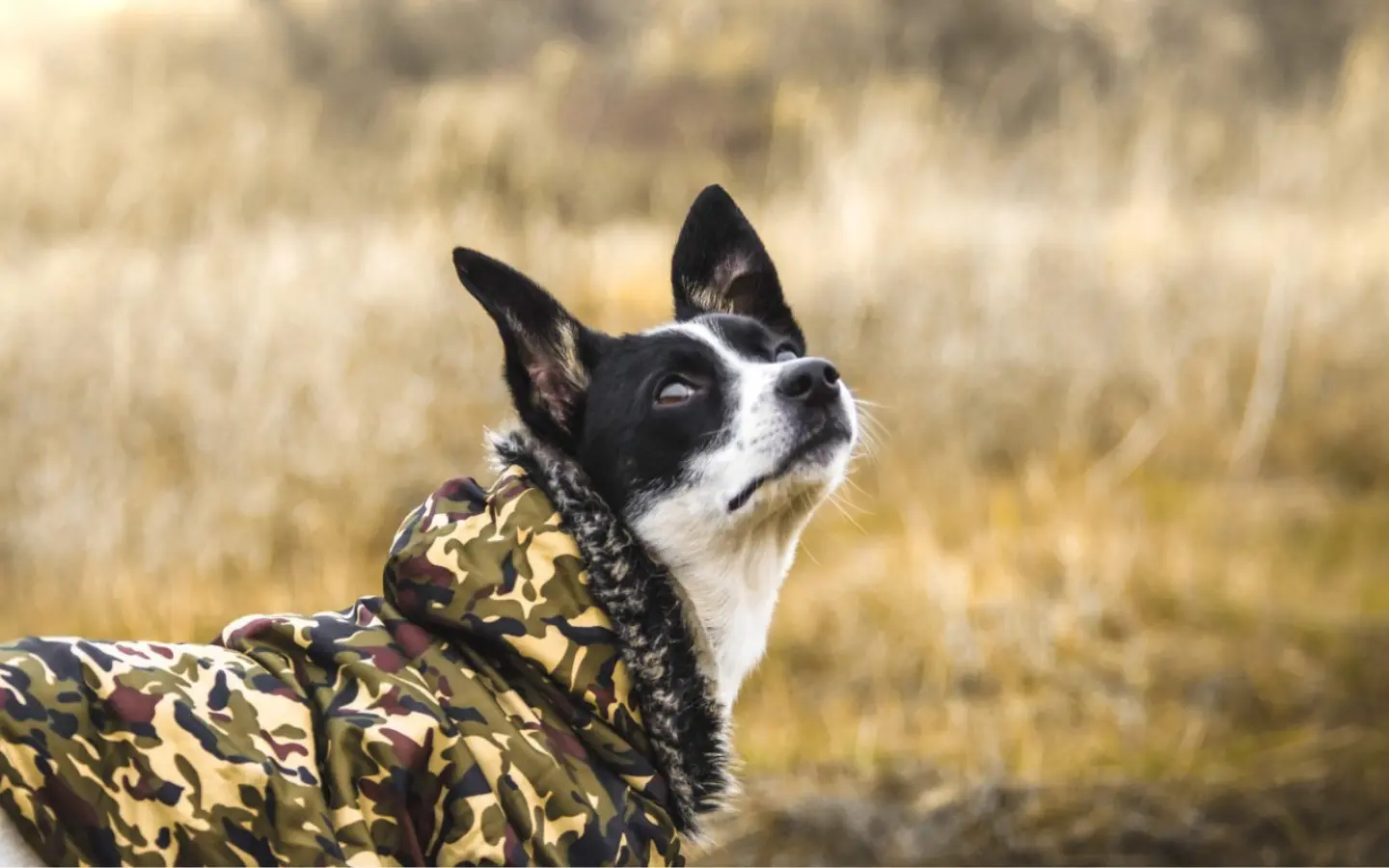
When training dogs in raincoats on rainy days or in damp environments, it is necessary to take into account safety, comfort and training effectiveness. The following provides detailed suggestions from three aspects: raincoat selection, training adaptation, and health management to help the owner scientifically plan training activities.
First, the selection and matching of raincoats
Material and breathability
Give priority to choosing lightweight and waterproof fabrics (such as nylon and polyester fibers), and avoid heavy materials (such as rubber) that may cause stuffiness or slow movement.
Breathable design: The back, armpits or abdominal area of the raincoat should have ventilation holes or mesh to prevent sweat accumulation and skin problems.
Size and mobility
Accurately measure body shape: The length of the raincoat should cover the middle of the legs (to avoid tripping due to being too long), and there should be a margin of 1-2 finger-widths for the chest and neck.
Joint movement space: Ensure that the shoulder, elbow and hip joints can bend freely to avoid restricting actions such as running, jumping or sitting.
Functional design
Adjustable parts: Velcro, clips or elastic bands need to be flexibly adjusted to adapt to different training scenarios (for example, agile training requires a more close-fitting fit).
Reflective strips/fluorescent color: Enhance visibility in low-light conditions during rainy days to ensure safety.
Second, training activities should be well-matched
Adjustment of training type
Avoid high-intensity exercises: On rainy days, the road surface is slippery. Reduce actions that are prone to slipping, such as fast running and sharp turns. Instead, switch to low-intensity training (such as smelling and finding objects, basic obedience).
Shorten the duration of each training session: Raincoats may increase the physical burden. It is recommended to train for 10 to 15 minutes each time and take breaks between sessions.
Instruction and reward optimization
Simplify instructions: On rainy days, there is a lot of noise interference. Use short and clear commands (such as “sit” or “come”), and avoid complex gestures.
Strengthen the reward mechanism: Increase the frequency of snack rewards (such as 1.5 times the usual level), or use high-value snacks (such as freeze-dried and cheese) to stimulate enthusiasm.
Environmental safety assessment
Check the training ground: Avoid areas with water accumulation, mud or potholes to prevent the raincoat from getting dirty or the dog from slipping.
Control interfering factors: Choose areas with few people and vehicles to reduce stress responses caused by strangers or animals.
Third, health management and emergency response
Temperature and humidity monitoring
Prevent overheating: The temperature inside the raincoat may be 3-5℃ higher than the environment. During training, regularly touch the dog’s abdomen or behind its ears. If it gets hot, pause and remove the raincoat to dissipate heat.
Cold protection and warmth preservation: On cold and rainy days, it is necessary to wear waterproof shoe covers or thin thermal underwear to avoid hypothermia.
Skin and hair care
The inner layer of the raincoat is moisture-absorbent: Place an absorbent towel on the inner side of the raincoat to reduce direct contact between hair and the wet raincoat.
Post-training cleaning: Dry your entire body with a dry towel, with a focus on cleaning the floor MATS, armpits and groin to prevent fungal or bacterial infections.
Emergency response
If the raincoat is damaged: Carry a spare raincoat or waterproof cape with you to prevent your dog from catching a cold in the rain.
Sudden stress: If the dog shows excessive anxiety (such as trembling or refusal to move) due to the raincoat or the environment, immediately stop training, soothe it with snacks and move it to a dry area.
Fourth, long-term adaptability suggestions
Raincoat desensitization training
Simulate a rainy day environment at home in advance to help the dog adapt to the touch and sound of the raincoat (such as the sound of the raincoat rubbing).
In combination with snack rewards, gradually extend the wearing time until the dog can move around naturally.
Rainy Day Training Plan
Break the training into multiple short periods (such as 10 minutes each in the morning, noon and evening), and avoid continuous high-intensity activities.
Combine indoor training (such as instruction review and sniffing pad games) to balance the exercise needs in rainy days.
Summary
When training dogs in raincoats, safety and comfort should be the top priorities. By choosing raincoats reasonably, adjusting the training content and strengthening health management, the risks of training in rainy days can be effectively reduced. The owner needs to closely observe the dog’s behavior and physiological state, flexibly adjust the plan, and ensure a balance between the training effect and the dog’s well-being.