

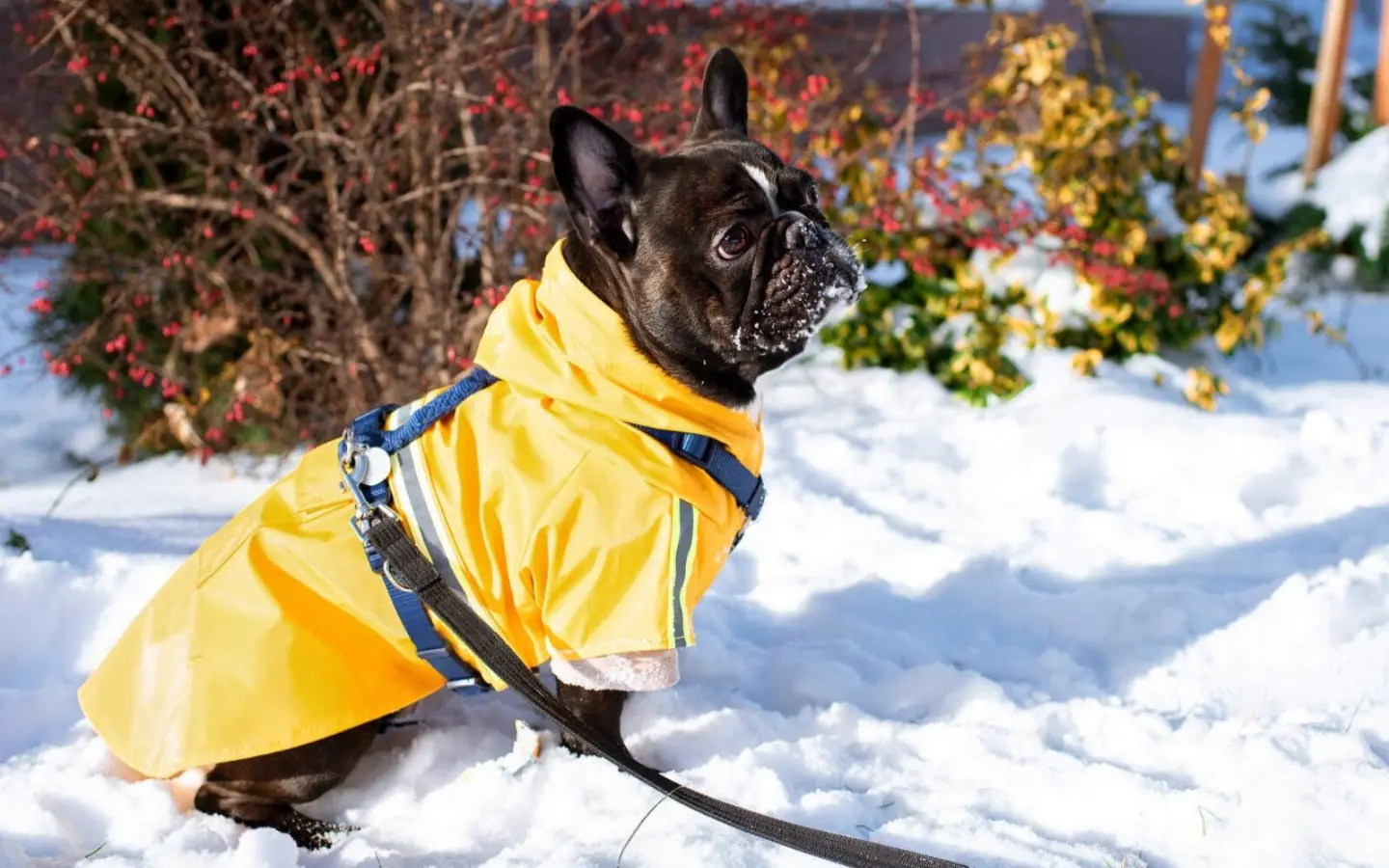
When walking on a slope, dogs wearing raincoats may fall or slide due to factors such as changes in the friction of the raincoat, imbalance of the center of gravity, and slippery ground. The following provides specific suggestions from four aspects: raincoat compatibility, walking skills, equipment assistance, and environmental safety to ensure the stability of dogs when walking on slopes.
First, the influence of raincoats on the stability of walking on slopes
Suggestions for Raincoat selection and adjustment
Length control: The hem of the raincoat should be shorter than the joint of the dog’s hind legs (tarsus joint) to avoid getting caught in the foot pads. If the raincoat is too long, you can fix the hem to your waist with rubber bands or Velcro.
Material selection: Prioritize anti-slip materials (such as nylon + rubber coating) or frosted surface raincoats to increase friction with the ground.
Tightness adjustment: Ensure there is no sense of restraint on the chest, back and abdomen, and allow the dog to freely move its forelimbs and hindlimbs. If the raincoat comes with adjustment buckles, you need to check the tightness again before walking.
Second, stability techniques for walking on slopes
1. Master control skills
Traction rope Angle:
Uphill: Keep the leash vertical upwards to prevent the dog’s hind legs from slipping due to pulling.
Downhill: Keep the leash at a 45° Angle downward and control the dog’s speed to prevent it from running up the slope.
Step guidance
Guide the dog to take small and slow steps with snacks or toys to avoid taking large strides that may cause imbalance.
If the dog slips, immediately use the “Stop” command and gently pull the leash to help it readjust its center of gravity.
2. Dog gait training
Center of gravity adjustment training
Simulate slope walking on flat ground and train the dog to shift its center of gravity forward (uphill) or backward (downhill).
Use the “forward” and “backward” instructions in combination with snack rewards to enhance the awareness of center of gravity control.
Anti-slip gait training
Guide the dog to walk slowly on a slippery floor (such as bathroom tiles) with snacks to adapt to a low-friction environment.
Third, precautions for the use of equipment
Rain boots fit well: Rain boots should fit the insoles. If they are too large, they are prone to falling off; if they are too small, they may squeeze the toes. For the first use, let the dog adapt for 10 to 15 minutes.
Anti-slip pad inspection: Regularly check if the anti-slip pad of the chest strap is worn. If the surface is smooth, it should be replaced in time.
Fourth, emergency response plan
When slipping: Immediately control the dog with a leash to prevent it from rushing down the slope due to panic. Check for any external injuries (such as sprains or abrasions).
Raincoat falling off: If the raincoat gets caught by a branch or slips off, make sure your dog is safe first and then quickly put it back on.
Exhaustion: If the dog shows signs of rapid breathing or slow gait, stop walking immediately, replenish water and rest.
Fifth, long-term adaptability suggestions
Slope desensitization training
Beginner: Walk on a gentle slope of 5° to 10°, and gradually increase the walking time with snack rewards.
Intermediate: Conduct a “sit – stand – walk” cycle training on a 15° slope to strengthen the control of the center of gravity.
Advanced: Simulate a slope environment in rainy days (such as spraying water mist) to train the dog’s stability on slippery slopes.
Muscle strength training
Hind limb strength: Strengthen the hind leg muscles through “climbing stairs” and “standing on the hind legs” training to reduce the risk of landslides.
Core strength: Enhance your dog’s core stability through “plank” or “yoga ball balance” training.
Health monitoring
After walking in the rain, check if the floor MATS are red and swollen and if the joints are stiff. Apply a special lubricant for pets if necessary.
If a dog frequently slips or resists walking on slopes, it is necessary to investigate whether it is caused by joint diseases (such as hip dysplasia).
Summary
When walking on slopes, dogs wearing raincoats need to enhance their stability by optimizing the raincoat design, mastering walking skills, using anti-slip equipment and assessing environmental risks. The owner needs to flexibly adjust the plan based on the slope, ground material and the dog’s physical condition, and enhance its adaptability through long-term training. If your dog shows obvious discomfort or slips frequently, you should take it to the hospital in time to check for potential health problems.