

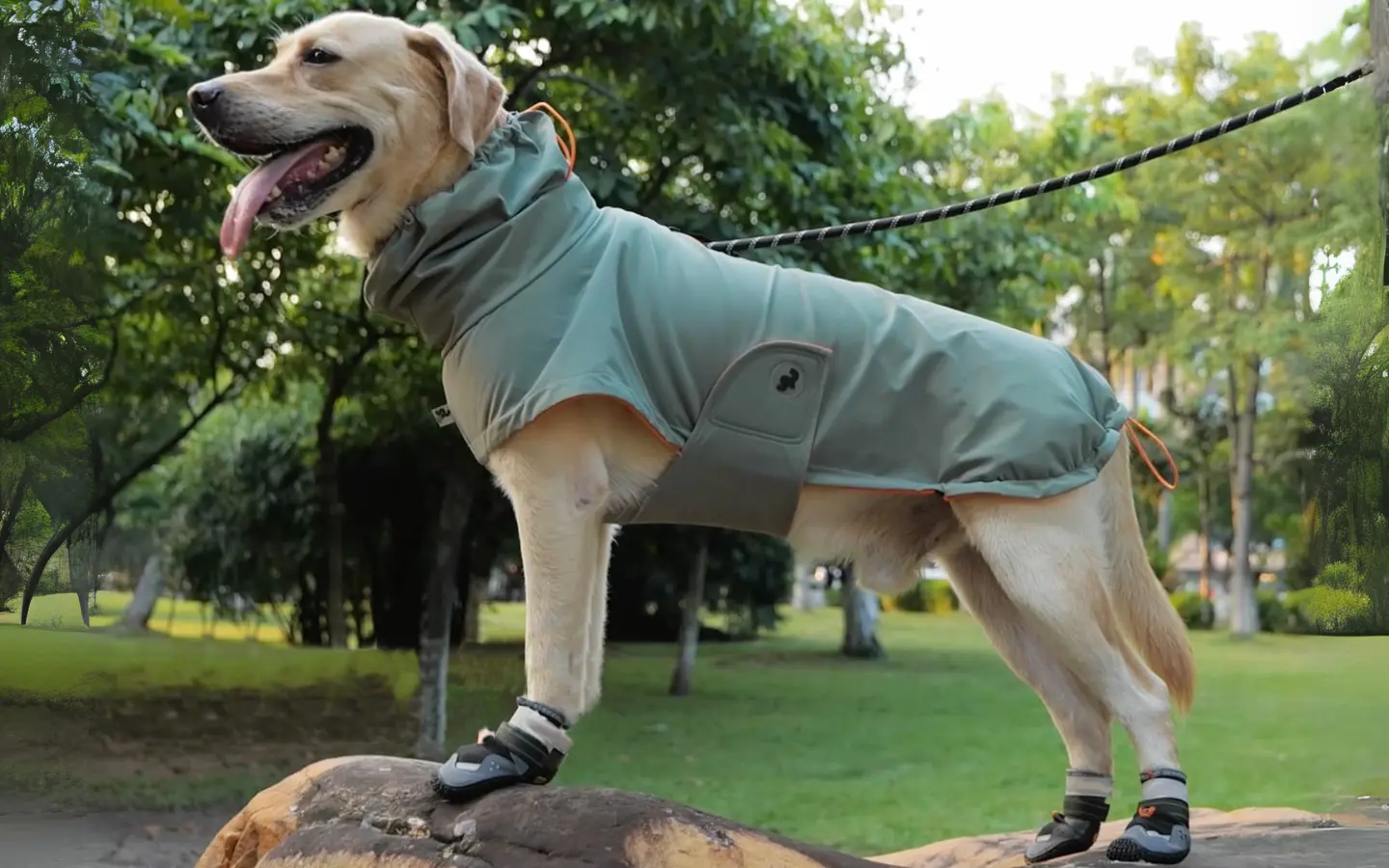
When choosing durable and well-fitting dog raincoats for large dogs, the material selection should take into account water resistance, wear resistance, breathability, structural strength and lightness, while also being suitable for the body characteristics of large dogs (such as long hair, well-developed muscles or exercise needs). The following is the specific material recommendation and purchase analysis:
First, core material recommendations
TPU coated fabric (thermoplastic polyurethane)
Advantages:
Strong water resistance: The TPU coating can form a dense waterproof layer, making it less likely to seep water in heavy rain.
Wear-resistant and tear-resistant: Suitable for the lively personality of large dogs and their outdoor activity needs (such as running and crawling through bushes).
Lightweight and soft: Softer than PVC coating, it reduces the restraint on dogs’ activities.
Applicable scenarios: Daily dog walking, outdoor activities in rainy days.
Note: It is necessary to choose products with uniform coating and no odor to avoid the pungent smell of inferior TPU.
High-density nylon (such as 600D or 1200D)
Advantages:
Wear-resistant and durable: The number “D” represents the fabric density. The higher the value, the more wear-resistant it is, making it suitable for rough use by large dogs.
Lightweight: Lighter than canvas, reducing the burden on dogs.
Easy to clean: The surface is smooth, and mud stains can be wiped with a damp cloth.
Applicable scenarios: Rainy areas and dog breeds that frequently engage in outdoor activities (such as Golden Retrievers and Labradors).
Note: A waterproof coating (such as PU coating) should be used in combination to enhance the rainproof performance.
Oxford cloth (thickened waterproof version)
Advantages:
High strength: Excellent tensile resistance, suitable for the muscle type of large dogs.
Good air permeability: Some Oxford fabrics are lined with mesh to reduce the feeling of stuffiness.
High cost performance: The price is lower than that of TPU or high-density nylon, suitable for those with a limited budget.
Applicable scenarios: Short dog walks in cities and moderate-intensity outdoor activities.
Note: It is necessary to confirm the waterproof grade (such as a waterproof pressure of over 3000mm) to prevent light rain from seeping in.
Soft shell fabric (professional outdoor material)
Advantages:
Three-in-one function: outer waterproof layer + middle breathable film + inner fleece layer (optional), providing both rain protection and warmth retention.
Elastic design: Some soft-shell fabrics contain elastic fibers (such as spandex), which fit the muscle lines of large dogs.
Applicable scenarios: cold and rainy areas, long-term outdoor activities (such as mountain climbing, camping).
Note: The price is relatively high, making it suitable for users who have high requirements for functionality and comfort.
Second, a guide to avoiding material pitfalls
Avoid PVC-coated fabrics
Disadvantage:
Heavy and stiff: Restricts the dog’s movement, and large dogs are prone to resistance.
Non-breathable: It can easily cause stuffiness and skin problems.
Prone to aging and cracking: The waterproof performance declines after long-term use.
Choose pure cotton or canvas materials carefully
Disadvantage:
Strong water absorption: It is prone to absorbing water and gaining weight on rainy days, increasing the burden on dogs.
Slow drying: It needs to be sun-dried for a long time and is prone to bacterial growth.
Poor wear resistance: Large dogs are prone to wear and tear when they are active.
Beware of the gimmick of “waterproof coating”
Some low-priced products are only sprayed with water repellent on the surface, and their water resistance disappears after washing. It is necessary to choose products with waterproof fabric itself or permanent waterproof coating.
Third, key points of fitted design
Adjustable structure
The neck circumference, chest circumference and back length all need to be adjustable (such as Velcro, snap fasteners) to adapt to the body size differences of large dogs.
For example, dog breeds such as Golden Retrievers and German Shepherds have significant differences in chest circumference, so it is necessary to choose a style with a wide range of chest circumference adjustment.
Three-dimensional cutting
The raincoat should fit the muscle lines of large dogs and avoid being too tight or too loose in areas such as the armpits and abdomen.
For deep-chested dog breeds such as Huskies, it is necessary to choose styles with a wider front chest.
Reserved activity space
There should be enough space left on the shoulders and legs to avoid affecting the dog’s running or jumping.
The rear legs can be designed with a split or elastic fabric to reduce the sense of restraint.
Through the above material and design screening, a durable, well-fitting and comfortable raincoat can be selected for large dogs, meeting their high-intensity activity needs and providing rain protection.