

Evaluation of ventilation performance of dog raincoats with reasonable ventilation hole design
The influence of vent hole design on ventilation performance
The design of the ventilation holes directly affects the ventilation performance of the raincoat. A reasonable layout of the ventilation holes can significantly enhance the comfort of the dog in rainy days.
The location and quantity of the ventilation holes:
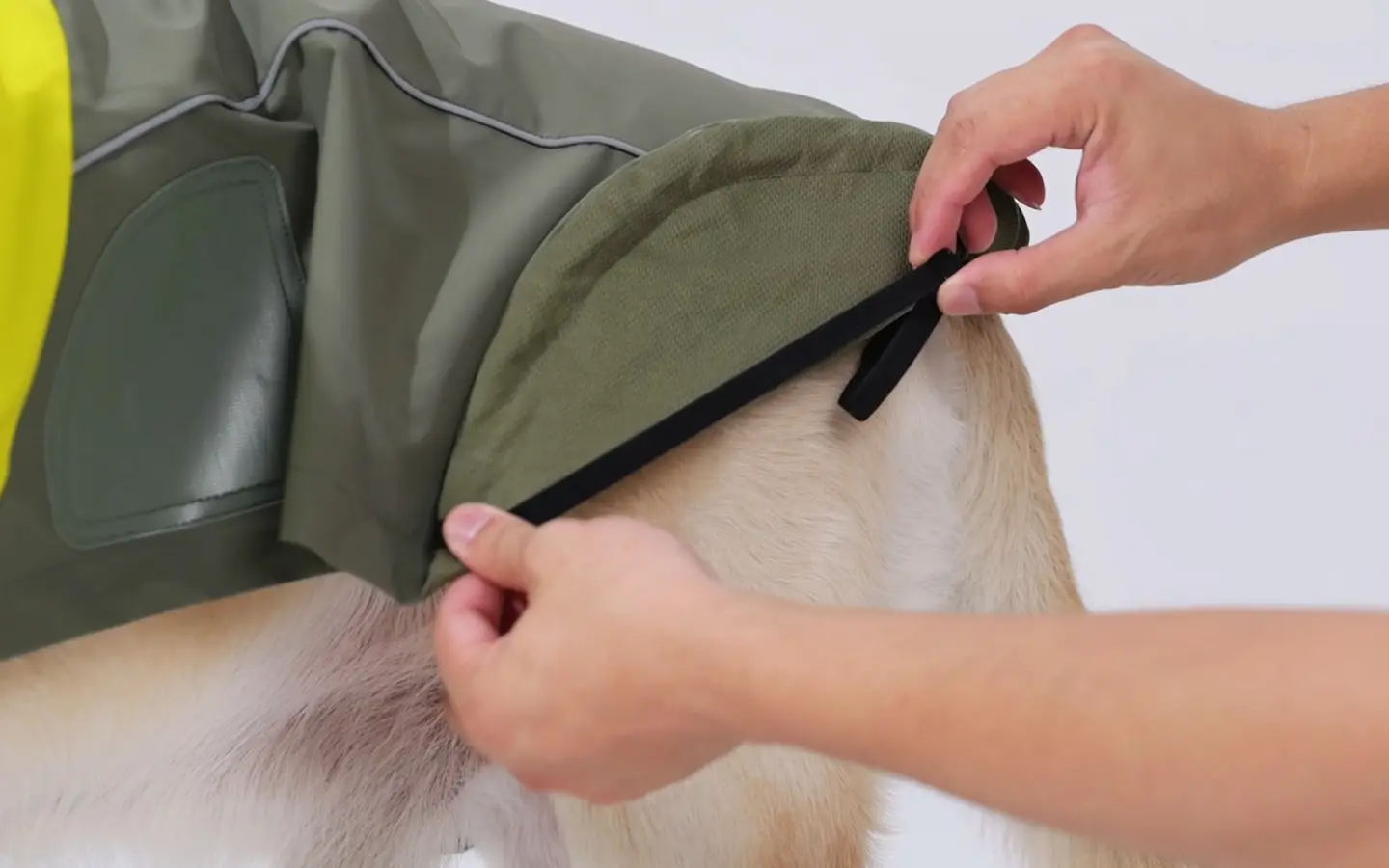
Armpits, back, and sides of the waist: These areas are where dogs tend to generate heat when they are active, and ventilation holes should be concentrated in these locations.
Moderate quantity: Too many ventilation holes may lead to a decline in waterproof performance, while too few cannot effectively dissipate heat. It is generally recommended to have 1 to 2 ventilation holes under each armpit and 2 to 3 on the back.
The shape and size of the ventilation holes:
Round or oval: Avoid sharp edges and corners to prevent scratching the dog’s skin.
The diameter is approximately 1-2 centimeters: It can ensure breathability without affecting the overall waterproof performance of the raincoat.
- Evaluation criteria for air permeability performance
To evaluate whether the design of the vent holes is reasonable, the following standards should be combined:
Air permeability:
Reference values: The air permeability of high-quality raincoats should be greater than 0.8-2mm/s, and the moisture permeability should be greater than 18000g/㎡/24H.
Test method: The YG461E computerized air permeability tester can be adopted, and the test should be conducted in accordance with the standard “Test for Air Permeability of Textile Fabrics” GB/T 5453-1997.
The balance between wind resistance and breathability
The relationship between air permeability and wind resistance: The higher the air permeability, the worse the wind resistance performance of the fabric, and vice versa. Therefore, the design of the ventilation holes needs to strike a balance between air permeability and wind resistance.
Solution: Use breathable membrane materials (such as Gore-Tex) or micro-porous breathable fabrics, which can not only ensure breathability but also effectively prevent wind.
- Recommendations for raincoats with well-designed ventilation holes
The following raincoats perform excellently in the design of ventilation holes and have good ventilation performance:
CARAT PLANET Explore X· The Breathing Raincoat:
Air permeability: Air permeability rate >0.8-2mm/s, moisture permeability rate >18000g/㎡/24H.
Design features: Made of Airshift nano-technology fabric, with a water pressure resistance of up to 15,000 mmH2O and a 3L fabric resistant to heavy rain. The ventilation holes are distributed in key areas such as the armpits and back, providing excellent ventilation performance.
BlackDoggy 2024 STORM-GUARD RAINCOAT
Breathability: Made of outdoor windproof and waterproof hard-shell fabric, it is light, thin and breathable.
Design features: Equipped with windbreak strips inside to block cold wind and rain, it does not catch lint and ensures comfort. The ventilation holes are reasonably designed and have good ventilation performance.
- User feedback and Evaluation
Comfort: Users generally report that raincoats with well-designed ventilation holes do not make dogs feel stuffy and hot, and dogs can move freely after wearing them.
The balance between water resistance and breathability: Users have indicated that these raincoats not only ensure water resistance but also perform well in breathability, allowing dogs to stay dry and comfortable even in rainy days.
Detailed design: The edges of the ventilation holes are treated smoothly and will not scratch the dog’s skin. Users have given high praise for this.